Blue Yeti Settings: Record Balanced Vocals & Acoustic Guitar
One of the most persistent challenges in my journey as an “advanced beginner” has been the technical side of home recording. Specifically: How do you record a vocal and an acoustic guitar at the same time without one overpowering the other?
Note: This blog post is specifically for my Blue Yeti and Ibanez V70CE. But I think the logic would apply to any single microphone that you use for recording your singing and acoustic guitar playing at the same time.
Usually, my Ibanez V70CE is the star of the show—whether I want it to be or not. It often drowns out the vocals, leaving the recording feeling unbalanced. After a series of tests in my basement studio with the Blue Yeti, I’ve finally found a “sweet spot” that works.
The Breakthrough: Optimized Blue Yeti Settings
If you are struggling with a “muddy” mix where the guitar is too loud, try these two adjustments:
- The Pattern (Bi-Directional): Most people default to Cardioid, but I found that the Bi-directional setting provides much better separation. It captures the “front” (my voice) and the “back” (the guitar) while rejecting the noise from the sides.
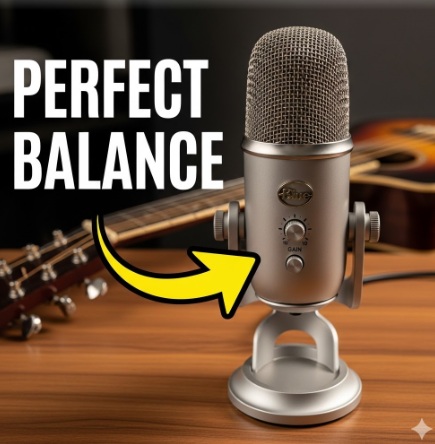
- The Gain (The 10 O’Clock Rule): I discovered that keeping the physical gain knob on the back of the Yeti at the 10 o’clock position (roughly 30%) kept the vocals crisp and clear without clipping, even when the guitar got loud.
I recorded a series of tests moving through different gain levels—from 9 o’clock all the way to “maxed out”—so you can hear exactly how the sound balance shifts between singing and acoustic guitar. As you increase gain, voice begins to lose out to the acoustic guitar sounds.
Gear & Placement Used:
- Mic: Blue Yeti USB
- Guitar: Ibanez V70CE
- Position: Mic is 18 inches from my mouth and 2 feet from the guitar’s sound hole.
This was a great reminder to keep that Shoshin spirit—always be willing to twist the knobs and try something counter-intuitive to get a better result.
Blue Yeti “Magic Sauce” for Recording Singing with Acoustic Guitar
Don’t forget, my Blue Yeti “magic sauce” for recording singing plus acoustic guitar were these three variables.
- Bi-directional mode. This was a surprising winner. It was slightly, but significantly better than the Cardioid mode.
- Microphone Placement. I spent some time on this problem. Currently I do not have a mini-book or larger microphone boom. So I was adaptive and just placed the microphone on an amp. The Blue Yeti was 18 inches from my mouth and 2 feet or greater from the acoustic guitar soundhole.
- Gain. In my repeated testing, in my research, I came to learn the importance of Gain adjustments. I found that for the Blue Yeti, under these circumstances, Gain at 10 o’clock was the best gain setting.
Share Your Single Microphone Advice in the Comments
What are your “go-to” settings for a single-mic setup? Do you use a Blue Yeti? Or do you use another single microphone for singing and acoustic guitar? Let me know in the comments!
Thank you.
I am recording a friend’s vocals with his guitar while I play piano. I use stereo for a great recorded sound with my Yamaha 7 ft grand. Thinking of recording piano first I had not realized the bidirectional setting would be great for vocal and instrumental. Thank you! I am curious because you didn’t show the actual Mike set up in your video. Did you have the mic horizontal with one side aiming up and one side aiming down or did you have one side of the by directional setting toward you and the opposite side toward the room? I’m sorry, but this part was not clear to me.
Here is a link to a video I made with my Blue Yeti set on stereo.
https://www.facebook.com/share/v/17bhFbjNoY/?mibextid=wwXIfr
Maggie,
First, thanks for your comment. Always nice to find on on my website. I did answer this for you via Facebook Messenger.
My Blue Yeti Professional microphone setting that I tried was bi-directional as you know. The microphone is straight up, not tilted at all. Just face the mike with its logo facing you. Position the other performer on the back side of the microphone. It should work.
Although not intended as some musical microphone, my Blue Yeti Professional gets the job done. In bi-directional mode you are emulating the classing interview setup. The interviewer faces the mike, the other person is on the backside of the mike.
Per AI (Gemeni), the Blue Yeti Professional has 3 receptors or condenser capsules. Per AI they “face outward”. My guess is that the Blue Yeti Pro condenser capsules are are at 120 degree separation pointing outward. It’s important to remember the Blue Yeti Pro is a “side-address” microphone. You speak from the sides, not the top of the mike.
If it were me, since I am a bit techy, I would put the gain at maybe 10 o’clock and then try short recordings in all 4 modes. Pick the best sounding two modes: perhaps stereo and bi-directional. Then perhaps do a “gain test” with gain at 2 o’clock to compare the recordings. It’s surprising how gain affects our recordings. Sound engineers know this, we do not.
Thanks again for your comment. Since I type waaaayyyyy better and faster than I play guitar, I gave you a detailed answer 🙂