Recording Roadmap: A Simple, Honest Path to Better YouTube Recordings
This post is for players who want to record more guitar music on YouTube — not just buy more stuff.
I Wish to Be Upfront About Recording Guitar Music for YouTube
I want to be upfront about something: I am not chasing perfect sound, cinematic video, or influencer status.
I am an advanced beginner guitarist who sings a bit — learning in public.
This post is my real recording journey. Not theory. Not gear flexing. Just what I actually did, what worked, what confused me, and what I learned along the way.
If you are Shoshin-minded (beginner’s mind), Kaizen-oriented (small improvements), and budget-aware, this path may resonate with you.
My Early YouTube Guitar Recording Setup (Phone Only)
My very first guitar-and-voice recordings were done with nothing more than a phone.
No mic. No interface. No editing. Just press record.
The quality wasn’t great — but it was honest. And more importantly, it got me started.
That matters more than people admit.
Tip: Don’t wait for perfect gear. Start with what you have and learn the process first.
Adding a USB Microphone: Shure MV5 + Phone Recording
My next step was adding a Shure MV5 USB microphone while still recording video on my phone.
This was a big jump in clarity:
- Voice sounded cleaner
- Guitar had more definition
- Less room noise and distortion
It was still a one-mic solution, but a much better one. For a beginner YouTuber, this was a very good place to be — and honestly, good enough for many people to stop right here.
Upgrading to the Shure MV51 — and What I Learned
Later, I purchased a used Shure MV51 thinking:
“This will be my ultimate one-mic solution.”
And to be fair — it is better than the MV5:
- Fuller sound
- Better presets
- More flexibility
But something became clear fairly quickly:
One microphone can’t always do two very different jobs well at the same time.
That’s when I realized I was heading toward something else.
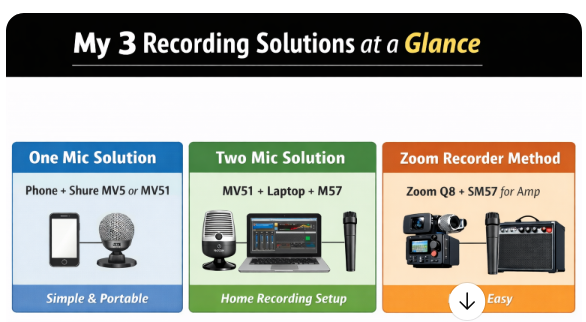
My Three Practical Mic Solutions for Recording Guitar Videos
This was the turning point for me. I stopped thinking in terms of gear and started thinking in terms of use cases.
I now think in three simple recording solutions — not as rules, but as options.
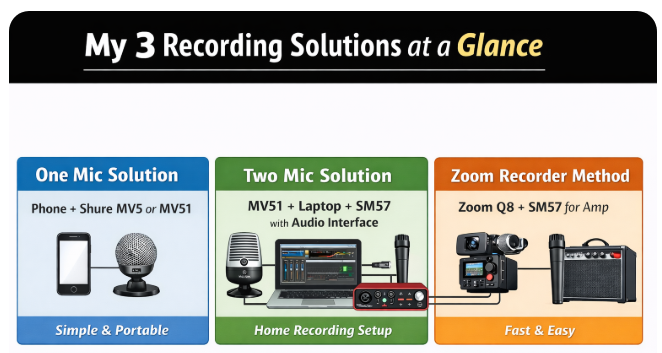
Note: I started with a Shure MV5 and am now advancing to a Shure MV51 (better). They are both condenser microphones with a cardioid pattern. I plan on using a dynamic microphone — a Shure SM57 — for amp recording when I need it. Finally, Dave Simpson on YouTube uses a Zoom Q8-style portable recorder. Use whatever you already own or what seems reasonable in cost.
The Two-Mic Solution for Home Guitar Recording (Educational, Not Mandatory)
With help from ChatGPT, I finally understood how a two-mic setup could actually work for me:
- Shure MV51 → vocals (and sometimes acoustic guitar)
- Dynamic mic (e.g., Shure SM57) → electric guitar or bass amp
This approach requires:
- A laptop
- XLR cable → audio interface (hardware) → USB into laptop
- A simple DAW as software on the laptop
- Syncing audio with video
Learning this was hugely educational. Even if I don’t use it every day, it made me a more literate YouTuber.
It also taught me an important lesson:
Just because you can do something doesn’t mean you need to do it every time.
Quick pre-recording checklist:
- Acoustic or electric guitar?
- Singing involved?
- Do I want to mix later — or keep it simple?
The Portable Recorder Method (Inspired by Dave Simpson)
Then I re-watched Dave Simpson’s video, “How I Make My Videos.”
His approach is refreshingly simple. Dave uses a portable Zoom-style recorder:
- One recorder
- Built-in stereo mic for voice and room
- One external mic (often a Shure SM57) for the amp
- One file
- No DAW
- No syncing
That hit me hard.
Because what Dave values — speed, simplicity, and consistency — matters more to me right now than perfect separation or studio polish.
This method would require:
- A portable recorder (Zoom Q8 or similar)
- A Shure SM57
- No computer mixing
- No audio headaches
Dave Simpson’s Expanded Recording Setup (Optional)
Dave’s fully scaled setup adds:
- A dedicated vocal mic (often a Shure SM58)
This allows maximum flexibility for singing, electric guitar, acoustic guitar, and bass.
But honestly?
That’s more money than I want to spend right now.
And I’m okay with that.
Common Guitar Recording Mistakes I’ve Learned to Avoid
- Overthinking gear before understanding workflow
- Buying multiple mics and interfaces at once
- Waiting for the “perfect setup” instead of recording
- Ignoring room realities and basic mic awareness
Recognizing these early helped me stay focused — and keep recording.
Where I Am Now With Recording Guitar Videos
My actual path is clearly Steps 1–4.
Steps 5–6 are optional, not mandatory.
I love the simplicity of Dave’s approach. But I don’t need to buy everything today.
I remind myself:
- I am Shoshin — learning with a beginner’s mind
- I practice Kaizen — small, thoughtful improvements
- I am retired — money does not grow on trees
Gear is not the goal.
Recording comfortably and consistently is the goal.
Final Thoughts: Recording Guitar for YouTube Without Overbuying Gear
If you’re stuck wondering, “What should I buy next?” — my answer is simple:
Use what you have until it clearly limits you.
Phone recording. One mic. Two mics. Portable recorder.
These are just tools — to be adopted when the time is right.
That mindset has kept me recording, learning, and enjoying the process.
And that’s the real win.